Top Picks

Showing posts with label Features. Show all posts

A Neat Experiment: Drinking Whisky with Salt

0

A Neat Experiment: Drinking Whisky with Salt

I remember not that long ago when the interwebs were abuzz with talk of adding salt to your coffee as an alternative to sugar. At the time, I thought it was some of the biggest wank I had ever heard…But I tried it anyway.

The theory behind this seemingly counterproductive practice is that sodium chloride (or common table salt) acts as a flavour enhancer when added to our food; it makes everything taste better, in moderation.

Humans have been aware of the amazing properties of salt for thousands of years, using it not only to enhance flavours but also for food preservation and to hide the taste of spoiling. Adding salt enhances (or changes) our sensory perception of flavour. In low concentrations, it can suppress bitterness and enhance other tastes. Salt is added to all manner of dishes (both savoury and sweet) often with a noticeable enhancement of flavour, salted caramel anyone?

Perhaps surprisingly, if you add a small pinch of salt to black coffee, it reduces the bitterness in a similar way to how sugar masks bitterness by increasing sweetness…but without the calories. Add too much salt however and it overpowers everything else, making the coffee taste unsurprisingly salty which is undesirable, to say the least.


Just the thought of adding salt to a $250 single malt, is enough to cause any whisky snob to shit the bed. 


Alcohol and salt is not a new combination; who hasn’t had tequila and salt shots? Adding salt to cocktails isn’t new either. Some common cocktails are traditionally served in a salt-rimmed glass or even served with salt or a saline solution already mixed in.

Whisky on the Rocks(alt)


I thought it would be neat (see what I did there?) to add salt to single malt whisky and see if it enhanced or at the very least, changed the flavour. I’m all for new whisky experiences here at Whisky Dad and I’m a firm believer that you should enjoy your whisky, however you damn please; neat, with water, on ice, with a mixer or even a pinch of salt. To hell with what anyone else thinks. Just the thought of adding salt to a $250 single malt, is enough to cause any whisky snob to shit the bed.

So with that in mind, let’s begin.

I’m going to start with three identical pours of Bruichladdich PC12 ‘Oileanach Furachail single malt Scotch whisky and add salt to the second and third glass. I don’t own a set of scales able to measure down to the milligram so I used my own measurement of a poofteenth of dry salt for the first glass; not just any salt, but fancy Maldon sea salt flakes. You can see in the picture what a poofteenth of fancy salt looks like in practice. 

A 'poofteenth' of fancy salt

For the third glass, rather than sprinkle dry salt crystals into the liquid, I prepared a 3% saline solution (3g of salt to 97ml of distilled water, roughly as salty as sea water). I did this so I could add it to the whisky gradually, one drop at a time. Obviously, this will add a tiny bit of water to the whisky which on its own has an effect on alcohol concentration, aroma and flavour, but it ensures that the salt is fully dissolved before being added to the whisky.

This is what I thought of Bruichladdich PC12, neat.

Aroma: Bottled at 58.7% ABV, you can smell the alcohol quite prominently but there is plenty of peat smoke to go with it. Once you get past the alcohol and smoke, there is a pleasantly rich and sweet aroma of alcohol soaked sultanas and citrus fruit notes.

Flavour: Bitter smoke dominates the palate initially before sweet fruits and prickly spices become more noticeable as the whisky warms in the mouth. The high ABV leaves the mouthfeel more prickly than smooth on the palate.

Finish: Long bitter smoke finish leaving a slight warming in the chest. Lingering aftertaste of smoke that stays in the mouth long after the drink is finished.

Now to add some fancy salt…

Note: Bruichladdich PC12 is a whopping 58.7% ABV and sodium chloride dissolves much easier in water than it does in alcohol. So, the higher the alcohol concentration in a whisky, the harder it will be for the salt crystals to dissolve. I had to crush the relatively large salt flake crystals after I had added they to the whisky in order for it to dissolve sufficiently.

Aroma: Perhaps unsurprisingly, it smells very similar to how it did without salt. Can I tell the two drams apart from smell alone? I’m not sure I can. I swapped backwards and forwards between the two, concluding I could not discern any noticeable difference in the aroma, although my wife said she could; but I didn't tell her they were the same whisky, so she may be full of shit.

Flavour: Now this is different. I’m looking for the salt, so I pick it up on the tongue almost instantly, but it soon disappears as my taste develops. After that initial salty pop, the whisky tastes noticeably less bitter with a different mouthfeel. The liquid feels slipperier on the tongue. The spicy prickle is reduced somewhat; the whisky tastes smoother but not subdued in flavour. I think the difference in the mouthfeel is more noticeable than any change in the balance of flavours.

Finish: Nowhere near as bitter as before, but the spicy prickle comes back with a vengeance in the finish with some flavour of roasted nuts that I didn't pick up before.

And finally adding 3% saline solution one drop at a time.

Note: Although this was a more effective way to add salt to the whisky, it was not ideal. As well as introducing additional water, the concentration also changed continually as I took sips and continued to add the saline solution. At one point I stopped, repoured a fresh 30ml dram and added approximately 1ml of saline solution - less water than I would generally add to whisky but I felt if I added much more it would be too salty.

Aroma: Once again, no discernable change in aroma with five or less drops of saline solution. The smokiness and alcohol fumes reduced with 1ml of water with the fruity aromas a little more noticeable as a result, but I attribute this to the water in the solution rather than the salt.

Flavour: I noticed a slight change in taste after just five drops of saline but not the obvious salty pop as I did with the addition of dry salt crystals; the bitterness began to reduce. The mouthfeel began to change above the five drop mark, developing a slippery oily feel. At the 1ml mark, the whisky was pleasantly balanced and tasted smoother than if neat. The salt was just noticeable at the outset but nowhere near as obvious as with the addition of the dry salt crystals.

Note: I have previously commented that the Bruichladdich PC12 tastes a little flat with the addition of water, but I generally add much more than 1ml of water when tasting a whisky diluted.

Finish: If anything the prickly spices increased in intensity at first but with less of a bitter aftertaste. The intensity of the prickly spice reduced after more than five drops of saline solution was added - it was hard to tell if this was a result of the additional salt or just the water.

So What Did I Think?


There you have it; adding salt to whisky has little to no effect on aroma but definitely alters the mouthfeel and reduced bitterness, which is a common taste in heavily peated whisky. Adding the salt as a saline solution was easier but the additional water also interacts with the whisky somewhat. Adding the salt as dry crystals isolated the perceivable changes to being a result of the salt alone, but was troublesome since sodium chloride does not dissolve as easily in alcohol as it does in water.

I would have loved to have been able to say that the addition of salt also enhanced some of the subtler flavours in this whisky, but I could not confirm that with side-by-side tastings and I'm not going to bullshit you. The Bruichladdich PC12 is a very strong and heavily peated whisky with plenty of bitter flavours, which is primarily why I chose it since salt is proven to reduce bitterness in food. I found the addition of salt to be an interesting experiment that did have a noticeable effect to both the flavour and finish of the whisky, but it's unlikely I will be sprinkly salt on all my whisky from now on.

But...


But, I wasn’t satisfied to stop there; I had tasted the salt when I was expecting it, so I needed to do a blind test to be sure. Having surmised that both a poofteenth of fancy salt and 1ml of about 3% saline solution had a noticeable and not unpleasant effect on the flavour of the heavily peated cask strength whisky, I asked my trusty assistant (my wife) to prepare another three drams.

This time I would use a very different single malt Scotch, the unpeated and much lighter The Macallan 12 Year Old Double Cask. I poured three identical 30ml glasses of the Macallan and added dry salt to one and 1ml of 3% saline solution to another, keeping one glass additive free. I told my wife which glass was which and out of my sight, she marked the glasses A, B and C in mixed order for identification purposes. Finally, I sampled all three and chose my favourite.


The differences were subtle, obviously, neither salted sample was so strong that it was overpoweringly salty. They all tasted fine, but I noticed the following differences:

Glass A had a slight salty pop, oiler mouthfeel, stronger spicy prickle in the finish and was slightly less bitter. It tasted balanced and smooth and from my previous experience, I thought it was the glass with dry salt crystals added.

I picked up more honey notes in Glass B but it was also pricklier on the pallet and bitter in the finish. I picked this as the unadulterated sample.

Glass C was noticeably muted compared to the others, with a slight saltiness that I concluded must be a result of the saline solution being added.

And my favourite? Out of the three samples, I preferred the taste of glass A the most.

After choosing my favourite, my wife revealed which glass was which:

Glass A – dry salt crystals. (Winner, winner, chicken dinner!)

Glass B – neat.

Glass C – saline solution.

Well, well, so not only did I pick which sample was which in a blind test (not as obvious as you may think) but I also preferred the sample with a pinch of fancy salt dissolved in it. Adding the dry salt crystals was more involved than just sprinkling it in, as it took a little effort to make it dissolve completely in the whisky. The saline solution, on the other hand, contained the extra water which was fine with the cask strength Bruichladdich but to my tastes, noticeably muted the flavour of the 40% ABV Macallan.

Now you can either take my word for it or you can challenge your own whisky prejudices, throw caution to the wind and try it for yourself – you may be pleasantly surprised. Let me know how you go in the comments.


0 comments

Gunpowder Proof - The Explosive Origin of the Alcohol Proof System

1

Gunpowder Proof - The Explosive Origin of the Alcohol Proof System

Have you ever wondered where the term ‘alcohol proof’ came from or what ‘100 proof’ means or why 100 proof in the UK is different to 100 proof in the US? Well, wonder no more.

The term ‘alcohol proof’ was first coined in 16th century England and refers to a test to demonstrate the potency of an alcoholic spirit. Historical accounts of the test vary and it quite possibly could have been conducted using a number of methods, all with similar base principles. That said, there are many false truths regarding the origin and intent of this test in circulation and it took some investigating to separate myth and legend from credible facts.

Know your alcohol

An alcoholic spirit at its most basic is a solution, a mixture primarily of alcohol (ethanol) and water. Alcohol is more volatile than water and alcohol vapour will ignite if exposed to a naked flame. Water will not, so as you increase the ratio of water to alcohol in a spirit, it will eventually reach a point where the spirit will no longer produce enough flammable vapour to ignite.

So, if you want to test the potency of an alcoholic spirit, why not simply try to set it alight? Good question.

Most people will tell you the alcohol proof test was conducted by mixing a small amount of the spirit to be tested, with a quantity of gunpowder before attempting to set it alight; but why use gunpowder at all?

Keep your powder dry

The term ‘keeping your powder dry’ reputedly originated in an account of Oliver Cromwell during his Irish campaign in the mid-17th century, in which he instructed his troops to ‘put your trust in God; but mind to keep your powder dry’. However, the term was no doubt in common use far earlier by soldiers and sailors employing gunpowder-based weapons from at least the 12th century.

Gunpowder, or black powder, burns quickly when ignited and is a mix of 15% charcoal (fuel for the combustion reaction), 75% potassium nitrate (a source of oxygen for the reaction) and 10% sulphur (which lowers the reaction’s ignition temperature and acts as a fuel). The ingredients of gunpowder must be combined in a way to produce the physical conditions to facilitate combustion i.e. thoroughly mixed and ground together to the required consistency. This is important because if the mixture is disrupted, the gunpowder will not combust as desired or even ignite at all.

Gunpowder is hygroscopic, meaning it tends to absorb water and when damp will not ignite. The reason for this is the main ingredient of gunpowder, potassium nitrate, is soluble in water. Put simply, this means that if exposed to enough water, the potassium nitrate in gunpowder will dissolve, removing it from its delicate arrangement with the carbon and sulphur, making the gunpowder harder or impossible to ignite.

Some commentators claim that high strength spirts were required for naval operations due to their storage in close proximity to the ships gunpowder supplies.

The high alcohol or overproof strength would ensure that if the rum or gin splashed on or mixed with the gunpowder, the powder would still work. This suggestion is complete nonsense.

Gunpowder and ammunition was stored on board ships in the ship’s magazine, much like explosive ordnance still is on today’s warships. Any other hazardous materials are segregated from the magazine to minimise the chance of accidents or catastrophic events. All attempts were made to keep gunpowder dry on a ship, ensuring it was only exposed to the elements immediately prior to use. In fact great care was taken to protect the magazine from enemy fire, vermin and stray sparks or embers. It is ludicrous to suggest that a sailor’s grog had to be kept at high strength just in case it spilt on the gunpowder it was supposedly stored with.

Liquid currency

I have read many accounts of the origin of alcohol proof, complete with some rather tenuous reasons why things occurred. What was the purpose of this test in the first place?
In the British Empire, distilled spirits, often rum, was used as a form of currency where traditional notes and coins were in short supply. If you were a sailor being paid in rum, you would want to know your payment was to a certain standard and not watered down would you not? If that was the case, then I can understand why a test was developed.

Additionally, if this was the initial purpose of the test it may explain why gunpowder was used rather than just setting the spirt alight? Theatrics. It is a far more satisfying conclusion for a sample to burst into flame and smoke with a bang, rather than to burn silently with a barely visible flame. Perhaps quite a show was made of proving the strength of the rum ration? Or perhaps the test was just a means to part young and impressionable powder monkeys from their rum ration, rather than something conducted routinely on the ship?

The alcohol proof test is commonly agreed to have consisted of mixing an alcoholic spirit with gunpowder and then attempting to ignite it.

If the water content of the spirit was too high, the gunpowder would be left too damp to combust, once the alcohol fumes had burnt off. This was not the most scientific of tests since external factors such as temperature, the ratio of gunpowder to liquid or the time waited after soaking before igniting would affect the results. But if the intent of the test was to make a show, science had little to do with it.


At the end of the 17th century, the British Empire regulated distilling, simultaneously encouraging the distillation of alcohol and imposing a tax on it. 


Navy Strength

This relationship between gunpowder and rum probably explains why gunpowder became an intrinsic part of the alcohol proof test, at least within the British Navy. It would also make a convincing story of where the term ‘Navy proof’ comes from when describing a particularly potent alcoholic spirit. Unfortunately, that is also a fallacy. The term ‘Navy proof’ was first used in the early nineties - nineteen nineties - by an astute advertising department for a popular gin brand.

The tax man cometh

At the end of the 17th century, the British Empire regulated distilling, simultaneously encouraging the distillation of alcohol and imposing a tax on it. The tax was introduced as a way of controlling the production and sale of alcohol, curbing over intoxication, drunken behaviour and crime and last but not least, raising government revenue. Alcohol content was of little concern to the tax man at first, with gin being taxed at a lower rate than strong beer, until the introduction of the disastrous Gin Act 1736 and the more successful Gin Act 1751.

Some suggestions have been made that the alcohol proof test was used for tax collection purposes prior to the 17th century.

I could not find any evidence to support such claims. Although it does present a nice setup and believable reason why the test was invented; who doesn’t want to believe it was concocted by the government of the day so that they could tax the working man at a higher rate? Although it is believed the alcohol proof test originated in the 16th century, it is likely the practice became more common after regulated alcohol taxation was introduced and prior to more scientific means to test alcohol content were developed.

100 Proof

The alcohol proof test was used to determine if the alcohol contained within the tested spirt was above a certain concentration, rather than to gage the exact strength of the spirit. The numeral 100 in the term ‘100 proof’ appears to be an arbitrary figure used to denote the transition point between being under or overproof and was used for no other reason than as an easy way to communicate a greater or lesser alcoholic strength from the standard.

The scientific method

In the UK, the proof system for testing alcohol content was eventually replaced by measuring specific gravity, with a standard being agreed upon in 1816. By comparing the density of an alcoholic spirit with that of distilled water at the same pressure and temperature, is possible to accurately measure a spirit’s alcohol content. A spirit at 100 proof was measured to be approximately 57.1% alcohol by volume or ABV.

In 1824 the French chemist, Joseph-Louis Gay-Lussac proposed a sensible proof scale based on ABV, where pure water was considered ‘0 proof’ and pure alcohol or 100% ABV was considered ‘100 proof’.

That’s not how we do things in America

In 1848 the United States of America introduced its own alcohol proof system where 100 proof was defined as 50% ABV. Why? I have no idea. Perhaps because larger numbers are more attractive to consumers, so marketing something as 80 proof (40% ABV by the US scale) is more desirable than the same product labelled as 40 proof?

So there you have it, the explosive origin of the alcohol proof system.


Did you learn something from this article or do you think I’m wrong? Please let me know in the comments and I will produce more content like it in the future.
- Whisky Dad

1 comments

WhiskyDad Makes Whisky Jerky

0

WhiskyDad Makes Whisky Jerky


So my wife bought a dehydrator. “What’s a dehydrator?” I asked. “It heats up and dries out food,” she said. “Like an oven?” I replied. “Yeah, but it doesn’t get as hot.” I pondered her response for a moment, “So, like a shit oven?”

Every appliance has a silver lining

I’m used to my wife buying things that are supposed to make our lives healthier, but I didn’t really appreciate the ‘shit oven’ until I asked if it could make jerky!

Jerky, is meat cut into thin strips, often marinated, and then dried to prevent spoilage. It is super tasty and fairly good for you since it is a great source of protein without much of anything else. The shop bought variety is also very expensive considering what it is and how much you get in a packet.

I already had the dehydrator (you can also use a smoker) so I figured I would give making my own jerky a go and since I’m a WhiskyDad, I planned to marinate it in whisky.

Sriracha & Starward Bacon Jerky

First up would be bacon jerky. Why bacon? Because bacon, of course. I settled on making a spicy bacon jerky with a light and sweet, non-peated whisky. The spiciness would come from Sriracha sauce, store bought since I didn’t have the time or energy to make my own. I have only recently discovered Sriracha sauce (found in the Asian food section of your local supermarket) but this sauce made from Jalapeños, sugar or honey and garlic is freakin’ delicious. Where has this sauce been all my life? It is not what I would call a hot sauce, it's spicy, but it is a near perfect mix of spice, savoury and sweetness.

The whisky of choice would be Starward Wine Cask single malt Australian whisky.

Sounds expensive, but it really isn’t. Difficult to find outside of Australia but it’s one of the best value local whiskies commonly available. I often recommend it as a gateway whisky for anyone new to whisky or new to drinking whisky neat. It’s light and quite sweet so I thought it would pair with the bacon nicely.

I bought some smoked streaky bacon from Costco and prepared the following marinade in a ceramic dish:

90ml of Starward Wine Cask single malt whisky
90ml or 6 x Tablespoons of Sriracha sauce
2 x Tablespoons of Manuka honey (any honey would do or substitute perhaps half as much brown sugar)
3 x Cloves of fresh crushed garlic

I mixed all the ingredients in the dish and added 500g of bacon. Next, I sprinkled salt and pepper over the top, covered the dish with plastic cling wrap and put it in the fridge.

The bacon needs to marinate for three days, being turned in the marinade half way through with some more salt and pepper added.

After three days, I removed the bacon from the marinade and placed it on a chopping board. I sliced the bacon in half and then the widest part in half again so that all the pieces were roughly the same size. Next, I placed the cut pieces on some paper towel and gently removed some of the excess marinate with more paper towel. I didn’t want to remove it all but I also didn’t want it dripping with liquid when I put it in the dehydrator.

Finally, I laid the pieces of bacon onto the dehydrators removable trays making sure the pieces were not touching each other and gave them a last sprinkle of salt and pepper.

I set the dehydrator to 70˚C and the timer to five hours.

Half way though I rotated the shelves and after five hours I removed the jerky and laid it on pieces of paper towel. I placed alternating layers of paper towel, a single layer of jerky, then more paper towel onto a dinner plate. This removed a lot of oil from the surface of the jerky since bacon is much fattier than the meat you would generally use for jerky. Once the jerky had cooled to room temperature, I removed it from the paper towel and placed it in a plastic zip-lock bag for storage in the fridge. Jerky can last for a while, but I wouldn’t keep bacon jerky for as long as you would leaner beef jerky for instance – But let’s face it, bacon jerky is going to be eaten pretty quickly.

So how did it taste?

It tasted awesome! The texture was quite good. You want the jerky to kind of bend and tear. If it snaps, it’s cooked too much. If it bends without tearing or is floppy, it isn’t cooked enough. The Sriracha Starward Bacon Jerky had a savoury whisky flavour at first with a sweetness coming out as you chewed. Lastly, there was a spicy finish that was just the right amount of spice and not too hot; pretty much damn perfect for a first attempt, if you ask me.

It actually reminded me of tasting a whisky (although a bacon flavoured whisky) since the flavour developed as you ate it rather than hit you all at once. 

Peat Monster Beef Jerky

Next up, I decided to make a more traditional beef jerky. I chose a corned beef silverside, also purchased from Costco. Roughly shaped like a loaf of bread, this cut of meat was already quite lean and having already been cured in a salt brine it would dry quite well in the dehydrator. All I had to do to prepare the meat was to remove the thin layer of fat from one side and cut out a couple of fatty parts before cutting it into roughly one inch thick steaks. You need to cut across the grain for this step. The steaks were about the size and thickness of café-style slices of bread. Next, I placed each steak in a freezer bag and put them in the freezer.

This time the marinade would be soy sauce and smokey whisky based. I chose Compass Box Peat Monster as the whisky. The marinade was a mix of the following:

½ Cup of soy sauce
60ml or 4 x Tablespoons of Peat Monster whisky
2 x Tablespoons of Worcestershire sauce
1 x Teaspoon of garlic powder
1 x Teaspoon of smoky paprika powder
1 x Teaspoon of chilli powder
½ x Teaspoon of ginger powder
½ x Teaspoon of cayenne powder
1 x Tablespoon of Manuka honey

Once partially frozen, I removed the steaks I wanted to use and sliced them (with the grain this time) into 3mm thick strips. This made approximately 600g of beef strips that I then placed into a bowl of the marinade, covered it with plastic and put it in the fridge for three days.

I followed the same dehydrating process for the beef as I did for the bacon; five hours at 70˚C

So how did it taste?

The beef turned out great, as good as any packaged jerky you can buy and much cheaper to make yourself. It had a great chewy texture that almost melts in your mouth and while it didn’t have the same evolving flavour like the bacon jerky did, it delivered a nicely balanced savoury hit from first bite to last chew. The whisky flavour was quite subtle so you could probably use more if you wished. I have plenty of meat left over in the freezer so I may experiment with different whiskies for future batches but my first attempt was a hit.

So do yourself a favour and buy a ‘shit oven’ to make yourself some tasty whisky marinated jerky. It is super easy to do and the results were surprisingly amazing.
0 comments

Whisky Weight: Can Drinking Whisky Make You Fat?

4

Whisky Weight: Can Drinking Whisky Make You Fat?

What a time to be alive when ‘low-carb’ potatoes are something you can actually buy – I’m not kidding. Carbs and calories are being discussed more than ever but do you know how your drinking is affecting your waistline? Here are some quick tips to help keep your calories from alcohol intake in check.

Know your units

In dietary terms, 1 Cal (big C) is actually 1 kcal or 1 kilocalorie. This is commonly referred to as a food calorie and is approximately the amount of energy required to raise the temperature of one kilogram of water by one degree Celsius at one atmosphere of pressure.

From now on, when I refer to Calories (Cal), I am referring to kilocalories.

In the metric system, 1Cal equals approximately 4.2kJ or 4.2 kilojoules.

Alcohol by volume or ABV is expressed as a percentage (%) and is a measure of how much alcohol is contained in a given volume of an alcoholic beverage.

When referring to alcohol proof, US 100-Proof is the equivalent of 50%ABV whereas UK 100-Proof is the equivalent of 57.15%ABV. Whisky can be any ABV from 40% to as high as 70% (rarely higher). Typical whisky ABV is 40%, 43%, 46% or >50% for cask strength.

The Metric unit of measurement for the volume of a liquid is ml or millilitre. Whisky bottles are typically either 500ml, 700ml, 750ml or 1,000ml (1 litre) if bought at travel retail. A standard alcoholic shot volume is 30ml.

The Metric unit of measurement for the mass is g or gram; In Australia, a standard drink refers to 10g of alcohol (a US and UK standard drink are 14g and 8g respectively). A single 30ml measure of a 40%ABV whisky equals 1 Australian standard drink.

How do I calculate the number of Calories in my whisky?

1ml of alcohol weighs approximately 0.787g (0.787 is the specific gravity of ethyl alcohol at 25˚C) and 1g of alcohol contains approximately 7Cal. 

First, work out the amount of alcohol in grams (g):

   (ABV% x 0.787 x volume in ml)/100 = Alcohol in grams (g)

Therefore, the amount of alcohol in a single 30ml measure of a 40%ABV whisky would be:

   (40 x 0.787 x 30)/100 = 
= 944.4/100
= 9.444g

Then, multiply this figure by 7 to determine the number of Calories (Cal):

   9.444 x 7
= 66.1Cal or 278kJ

Likewise, the Calories in a single 30ml measure of a 60%ABV whisky would be calculated by:

   (60 x 0.787 x 30)/100
= 1,416.6/100
= 14.166g

Then, multiply this figure by 7 to determine the number of Calories (Cal):

   14.166 x 7
= 99.2Cal or 417kJ

If only it was that simple

What you have just calculated above is the calories of alcohol in your whisky. What this doesn’t take into account is any additional energy from residual sugars, mixers or the physiological effects of alcohol on the way your body processes energy. Let’s look at each in turn.

Residual sugars

Whisky, like beer, is produced by fermenting sugars from grains. Grains such as malt are used because they contain concentrated stores of energy in the form of starches that can be easily converted to sugars. The majority of sugars are consumed by yeast during fermentation but depending on fermentation methods and added ingredients, the residual sugars within the finished beer or whisky wash will vary. Most of the residual sugars in whisky are lost during distillation which means whisky contains very little energy from sugars; but it does have some, just a negligible amount when calculating Calories.

Mixers

If you drink your whisky with a mixer other than water, you are most likely adding plenty of Calories from sugar (unless the mixer is artificially sweetened). Refer to the mixer packaging for details but for example, 100ml of Coca-Cola contains 76Cal. But beware, the sugar content of your favourite mixers may vary depending on country of origin.

The effects of alcohol on your metabolism

When it comes to whisky and weight gain, the following is the kicker. Most people don’t consume huge amounts of whisky in a single sitting but even if you drank half a bottle (350ml) of 40%ABV whisky, you are only consuming 771.5Cal (3,239.5kJ) from alcohol. But, half a bottle of whisky is a significant amount of alcohol, just over 11 Australian standard drinks.

On average, it takes your body one hour to process one standard drink or 10g of alcohol.

Why is this important? Your body will always metabolise alcohol before it metabolises anything else. Why? Because the primary product of alcohol metabolism is acetaldehyde, a toxin, which must be processed by your body before more alcohol can be metabolised in order to avoid poisoning. Your body makes this process a priority, essentially halting the metabolism of any other energy source until it is complete. That means that any Calories consumed other than Calories from alcohol, will be converted to fat until all the alcohol is out of your system. So, anything you eat in the 11 hours after consuming half a bottle of whisky, will be converted to fat stores rather than metabolised by your body. Beware, this is the trap that most of us fall into when combining alcoholic beverages and food.

The bottom line

In most cases it isn’t the whisky making you fat, it is whatever you eat or drink with it, while alcohol remains in your system. So, rethink that drunken late-night kebab or just don’t drink half a bottle of alcohol in one sitting. In fact, if you are concerned about your health, probably do both.
4 comments

Help Me Plan My Trip To Scotland In 2018 - Part One

0

Help Me Plan My Trip To Scotland In 2018 - Part One


In a little under a year, Dad-of-WhiskyDad (i.e. my Dad) and I, will be travelling from Australia to Scotland for a 28-day whisky adventure!

We will be arriving in the UK around May 21st, next year, flying in and out of Manchester Airport and hiring a car to get around. There are a few things we really want to do, but for the most part we are open to suggestions for the must see, must do, Scottish whisky experiences.

In order to maximise enjoyment and minimise the need to stick to a strict schedule, of the Scottish Isles we will only be visiting Islay. As much as I would love to visit them all, I would rather spend a few days on Islay and save the others for another visit. We will also be spending a significant amount of time in Campbeltown since the timing of our trip is intentional to align with the Campbeltown Malts Festival and hopefully a five-day Springbank Whisky School as well. I imagine we will spend some time in and around the Highlands and Speyside in the second half of the trip and visit Edinburgh on the way back south.

Dad-of-WhiskyDad spent his childhood in an English town called Corby, after my grandparents moved there from Scotland; so we will finish our trip in Corby and have a few ‘Where Did I Come From’ moments along the way.

How Can You Help?

If you have been to Scotland before, what are your must-see whisky experiences? Distilleries we must visit, tours we must take, places we must go, people we must meet and sights we must see. Or perhaps you know a few whisky secrets you are willing to share? This will be an ongoing process and I will keep you abreast of the plan leading up to the trip itself and of course, I will blog my experience whilst over there.

If you would like to make suggestions to help shape our Scottish whisky adventure, please do so either using the comments at the end of this post or via the WhiskyDad Facebook page or Twitter.


0 comments

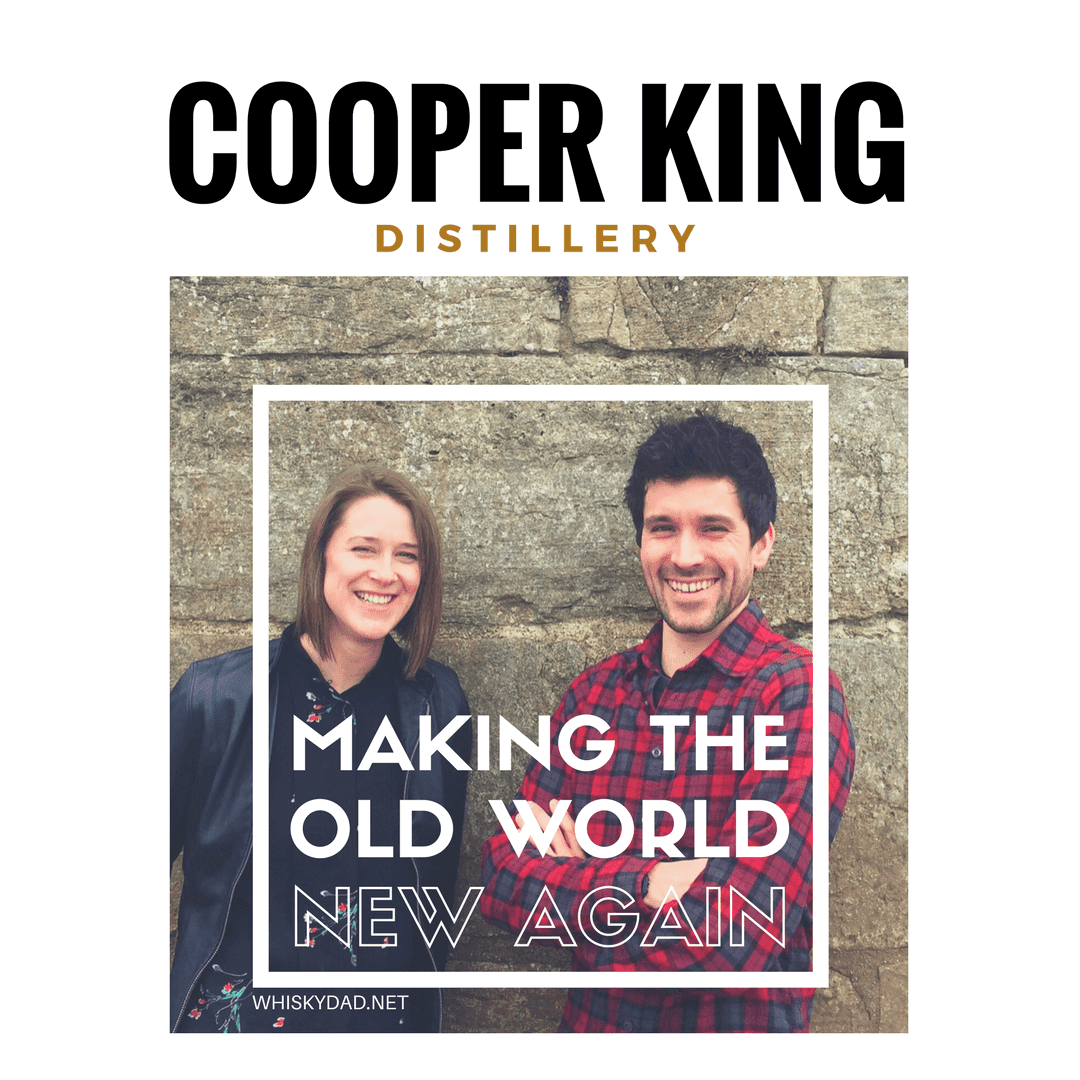
Cooper King Distillery: Making the Old World, New Again

0

Cooper King Distillery: Making the Old World, New Again

Inside a disused stable block just north of the historic English city of York, is a space reserved for a shiny copper still unlike any other within 17,000km. Designed and constructed in Tasmania, Australia, this still will soon travel from the opposite side of the world to become an integral piece in Abbie Neilson and Chris Jaume’s Cooper King Distillery; an extraordinary endeavour to undertake considering the amount of copper still manufacturing experience to be found in the UK. So why source a copper still from somewhere that wasn’t even settled by British explorers at the time the first whisky distilleries began to appear in Scotland? Well, to understand that, you need to retrace the steps of not the first settlers but those of Abbie and Chris, who set out for Van Diemen’s Land some 111 years later.

In 2014, Abbie and Chris, a successful scientist and an architect, set out across the seas in search of adventure and a break from the stresses of professional life.
Abbie and Chis on Tasmania's Overland Track.
Their journey led them to the island of Tasmania at the southern tip of Australia, where they visited each of the state’s whisky distilleries at the behest of a whisky blogging friend. At that time, Tasmanian Whisky was just emerging onto the world stage with relatively unknown Sullivan’s Cove Distillery having recently taken out the World’s Best Whisky for their French Oak Cask single malt at the prestigious World Whiskies Awards. The Tasmanian whisky industry was abuzz at the prospect that whisky from their little island could beat the traditional whisky producers at their own game. Who then wouldn’t be caught up in this excitement and think they could perhaps take something of this new world back to the old one?
We fell in love with Tasmania instantly,” says Abbie, “the welcoming people, the rugged landscape and of course the phenomenal food and drink we tasted thanks to the state’s many small-scale producers. 
Our visits to the whisky distilleries in particular, blew us away,” Chris adds, “we were meeting folk with incredible passion, relatively little industry experience, and an infectious Tassie ‘can-do’ attitude. They were approaching the challenge of producing whisky from all angles: we saw all manner of distillery buildings, stills, grains etc being used, and the end results were stunning. We came away from each distillery with a ton of questions which the next distiller would then answer. Though the more we found out, the more we wanted to know. We began to realise that to start a distillery you didn’t necessarily have to have Scottish roots or a £10million bank balance; it could be done on a small scale, on a limited budget, without compromise of flavour. The hands-on production techniques used by these guys, coupled with the limited volumes produced, was yielding some of the best whisky we had ever tasted. 
The seed was sown!” Abbie continues, “we had been whisky fans ever since our first trip to Edinburgh, we both enjoyed a challenge and we loved the thought of working together to craft a delicious spirit for us and others to enjoy. Over the next 18 months while away from home, we undertook training with Dean Jackson and Bill Lark of Redlands and Lark Distillery fame, visited countless other distilleries and tasting events, and wrote up our business plan. We were ready to hit the ground running when we returned to England late 2015. 
Tasmanians are a proud lot, island folk, fiercely independent of the ‘mainland’ but at the same time exceptionally accommodating.

There are few secrets in the Tasmanian whisky industry and everyone knows everyone; often not just on a professional level, but also on a personal one. Being a ‘local’ goes a long way when looking for help to start your own distillery, but that doesn’t mean you can’t become an honorary local if you show the same drive and passion for whisky as the local producers. Bill Lark, affectionately referred to as the Godfather of Tasmanian whisky, recognised the drive and passion in Abbie and Chris and took them under his wing, helping to impart his own knowledge and experience of which they would need plenty when they got back home.
Bill Lark and others in the Tasmanian whisky industry taught us a lot,” Chris revealed. “We learnt never to compromise on flavour, to not be afraid to challenge tradition and to go with our gut instinct. We also learnt the importance of provenance. People want a genuine story to get behind, and being able to visit the distillery, meet the makers, see the casks maturing and taste the whisky in the place where it’s made makes that bottle so much more than just a well-designed, well-marketed product. 
Bill Lark gave us lots of sterling advice,” adds Abbie, “especially around the business model and how we could potentially grow. He said to follow our instinct and that’s stuck in my mind ever since. Mark Nicholson, Dean Jackson, Peter Bignell, Casey and Jane Overeem, William McHenry, David MacLennan… All these fine fellows helped shape our distillery, offering at the time (and continuing to do so) fantastic advice and guidance. 
That was nearly 18 months ago and construction work at Cooper King Distillery is now underway.
Chris with Belgrove Distillery's Peter Bignell.
The copper still may be destined to become an integral and highly visible Tasmanian influence on this fledgling distillery but Abbie and Chris intend to implement much more of what they learned from their Colonial teachers. Tasmanian distillers are acutely aware of the ecological strengths of their beautiful island and they aim to both utilise the pristine natural resources and protect the environment that produces it. Tasmanian distillery Belgrove sets a benchmark for sustainable craft distilling. Founder Peter Bignell grows his own rye, made his own copper still from scratch, collects rainwater from the roofs of his sheds, heats it with biodiesel that he makes himself from waste oil (which also powers his tractors, forklift and truck), feeds his livestock used whisky mash and recycles waste water for irrigation. This focus on sustainability was not lost on Abbie and Chris as Chris explains:
We’ve sourced local barley (some of which we are hoping to have grown in the field next to us), partnered with the country’s last master cooper whose workshop is a 30-minute drive away, and are self-building the distillery. Much like the Tassie distilleries we visited, we want to produce a craft spirit with genuine provenance, in a space that we’ve designed. We’ve also been on a steep learning curve regarding the funding and running of a business. We’ve successfully applied for an innovation grant, a tree-planting grant, and for another to research into how we can reduce and reuse our distillery waste. We’ve also been pitching to investors and bought on a select few to part-fund the build. All of this has been completely new to us, incredibly challenging, all-consuming, but ultimately very rewarding! 
Comradery is something we have been trying to foster amongst the emerging English whisky distilleries,” adds Abbie, “inspired by the Tassie scene back in 2014. We produced an English whisky map to help inform the public of the fledgling industry and have been on a couple of 1000mile road trips around the country in our tiny Renault Clio, purposefully to visit as many of the other distilleries as we can and strike up a friendship. There’s still a few more to visit yet, and I hope our visits will lead to some exciting collaborations. 
Cooper King Distillery launched their Founders’ Club in May.

The Founders' Club is designed to provide the last piece of the funding puzzle which will allow Abbie and Chris to fire up the stills and get spirit flowing by autumn/winter this year. Members will be rewarded with first-release products, rare bottlings, distillery merchandise and lifetime membership. Abbie had this to say about the Founders’ Club:
We can't wait to welcome other fine fellows into the Cooper King family to share in the exciting times ahead. Our Founders make this whole project worthwhile; they will be the first to reap the rewards when the stills start flowing with our unique English spirit. 
Cooper King Distillery will be offering numerous Founders’ Club reward tiers ranging from £30 upwards, which will make great gifts for whisky and gin lovers. Memberships are limited and are on a first come, first served basis, so those who want a piece of the action are encouraged to act quickly. You can sign up to the mailing list here for more information and be informed of future developments.

The student becomes the master.

Australian distilling would not be where it is today without the influence, expertise and investment of early settlers and immigrants, but the local industry Down Under has matured into something much more than a mere clone of its European ancestors. It is now at the stage where unique Australian lessons and successes are being exported back to the UK and in a serendipitous turn of events are making the Old World, new again. There are certainly exciting times ahead and I look forward to visiting Abbie and Chris at Cooper King Distillery next year when I travel to the UK.
0 comments

What Is Independently Bottled Whisky?

0

What Is Independently Bottled Whisky?


The Internet is a wonderful tool for the whisky enthusiast. Discovering and acquiring whisky has never been easier, with a dizzying choice of both old and new whiskies just a few mouse clicks away. I often browse my favourite websites checking prices and availability, reading tasting notes and writing wish lists of my next whisky purchases. For example, I am currently holding out for the latest Springbank 12 Year Old Cask Strength and Laphroaig 10 Year Old Cask Strength expressions. Historically, both tend to arrive in Australia in very limited quantities and sell out quickly.

During these online browsing sessions, especially when I was first getting serious about whisky, I kept stumbling across odd whisky labels. These whiskies were not produced by a particular distillery, but rather were sourced from a variety of distilleries and bottled under a different branding such as Gordon & MacPhail, Signatory, Rest & Be Thankful and Heartwood. This process, I would eventually learn, was called independent bottling and it was a practice that had been going on for almost as long as whisky had been produced.

So what is independent bottling exactly?

To understand independent bottling, you must first understand the fundamentals of whisky production. Whisky is an alcoholic spirit made from distilling a fermented cereal and aging it in wooden barrels or casks (the terms ‘barrel’ and ‘cask’ are interchangeable). When the fermented cereal (usually malt, in the case of Scotch whisky) is first distilled, it is a clear liquid distillate referred to as new make. This new make is not whisky in a legal sense, although it will become whisky once it has been aged in wooden barrels for a minimum legal period or longer. During this aging process, the new make and wood undergo a variety of marvellous chemical reactions and tannins from the wood leach into the liquid imparting a more familiar whisky colour. Many factors affect the interaction between distillate and wood; such as how long it remains in the barrel, the type of wood used in the barrel, what the barrel held if anything prior to being filled, the thickness of the barrel staves, the amount of char inside the barrel, the size of the barrel and the average temperature, temperature variations and barometric pressure within the storehouse etc. That is a lot of very influential factors that occur after distillation.

The decisions about how to use these factors are the tools of the independent bottler. An independent bottler will source and provide their own barrel or barrels to a distillery, to be filled with a new make (or very young) spirit. This spirit may be the same used to make the distillery’s signature expressions, but that is where the similarities end. Whatever whisky is produced from that independent bottler’s cask will be unlike anything else the distillery makes and will quite often be unique to that particular cask or casks.

So now that you know independent bottling is more than just filling a barrel with someone else’s whisky, here’s an interview with ‘Caskologist’ George Koutsakis of Whisky Foundation, a new e-commerce venture specialising in independently bottled whiskies.

WD: Welcome George, what is a ‘Caskologist’ and what is your involvement with Whisky Foundation?

GK: We are a small, yet passionate, team here at Whisky Foundation and we all take on a variety of different roles. The term ‘Caskologist’ is an invented term which best describes the part I play in the organisation.

My job is basically to manage and stay on top of anything to do with the Whisky Foundation website. Working closely with our sales team, I add, research, and sample new products and observe the statistics to find which bottles are of greatest interest to our customers.

With my past expertise in whisky tasting and events, and my experience writing, I also manage the Whisky Foundation blog, and try to create the most educational and captivating content to keep our readers entertained. In order to do so I closely follow industry news and new releases.

WD: What do you look for when selecting a cask and do you already have a potential new make spirit fill in mind?

GK: This is a question better answered by the independent bottlers themselves. The wonderful Italian independent bottler Wilson & Morgan, who select the finest Scottish casks to join their collections, have produced a few exclusive bottles for Whisky Foundation. Their brand ambassador Luca Chichizola, who is co-responsible for selecting casks alongside chairman Fabio Rossi, had this to say:
It must be exciting to us. We have tasted more than 3000 malts in our lives so far. So it must be ‘different’, it must shine. It must not induce a yawn or an ‘OK, more of the same’ thought. Even if it's still immature and rough, it must have personality. About new make... not very interesting to us, if I may say so. We always buy whisky that is already 3 years old, so that it has lost its most undesirable traits of immaturity and it's easier to see where it will go. With rum on the other hand (Wilson & Morgan has a sister company called Rum Nation) we definitely buy new make either for bottling white rum or for maturation.
WD: Mass produced whisky is commonly chill-filtered and even non-chill filtered, non-cask strength whisky is usually allowed to rest to separate the less soluble particulate matter or ‘floc’ before bottling. What are your thoughts on whisky filtration and how does this affect Whisky Foundation bottlings?

GK: When it comes to whisky filtration, I am a firm believer in sampling the whisky in its most natural form. I find non-chill filtered whiskies provide a ‘fuller’ and ‘richer’ mouthfeel, due to the presence of fatty acids and proteins, which are removed throughout the process of chill-filtration.

Non-chill filtration gives drinkers a more natural and organic experience. That cloudiness should be welcomed. Most of the independent bottlings we have at Whisky Foundation come just like that, at cask-strength and non-chill filtered, giving the raw, intense, unique flavour I love most in my whisky.

WD: What are some of the things that independent bottlers could do that would not be possible or perhaps financially viable in a large distillery?

GK: A large distillery needs to focus on consistency. Several flagship releases take up most of the distillery’s production capabilities, which, sadly, can restrict distillers and make it hard for them to create unique, one-off releases.

Independent bottlers, however, only create unique, one-off releases, which means their sole purpose is to experiment, observe, and release whiskies that have matured for the right amount of time, providing balance above all else.

The fact that these organizations hold so many different casks from different distilleries means that they can choose exactly how they treat the whisky. They can create unique blends, and use unique methods to age and bottle a whisky. Two casks of the same Scotch can be aged in different kinds of oak, for a different duration, and at different temperatures. Experimentation takes the front seat when it comes to independent bottling.

WD: A lot of whisky drinkers enjoy the familiarity and availability of a large distillery’s flagship whisky. How do you convince these people to buy an independently bottled whisky that is often much more expensive and likely to never be repeated?

GK: Firstly, people’s preconceptions need to be challenged. I look at large distilleries and independent bottlers as two completely different entities, in the same way I might look at a hotel and a villa. We need both, and both provide us with an amazing, yet very different service.

A large distillery will give you your favourite dram over and over again, whenever you need it for years, even decades. An independent bottler will give you something different every single time, challenging you to explore, learn, and delve deeper into the world of whisky.

It all comes down to education. Whisky tastings, promotions, and a whole lot of information can make all the difference. Step by step, we simply need to introduce people to independent bottling and show them what makes the experience so special and satisfying.

With a little knowledge about independent bottling and a willingness to explore, it’s possible to find a wealth of under-recognised whisky gems.

WD: Thanks for your time, George, and for sharing your thoughts on independently bottled whisky.

GK: Thank you for having me, it’s been a pleasure.


If you consider yourself a whisky enthusiast, you shouldn’t ignore independently bottled whisky. Independently bottled whisky present an opportunity to try unique expressions sourced from your favourite distilleries. A lot of thought goes into the cask selection process yet even with years of experience the results can be anything but predictable. This dramatic and often unpredictable effect that ageing whisky in wood has, is one of the things I love about whisky. It is comforting to know that no matter where the whisky was distilled, I can always be surprised.
0 comments
Powered by Blogger.